
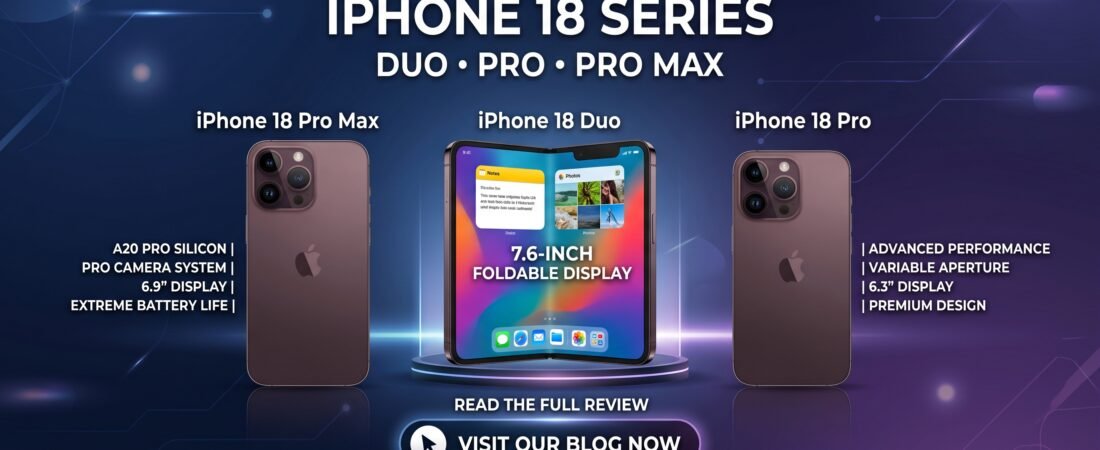
Apple has officially fractured its smartphone lineup in the best way possible. This year’s flagship release isn’t just an iterative update; it marks a distinct fork in the road for the premium smartphone market. On one side, the iPhone 18 Pro and Pro Max represent the absolute pinnacle of the traditional smartphone experience. On the other, the highly anticipated iPhone Duo finally pushes Apple into the foldable future.
Whether you are upgrading for computational power, cinematic photography, or sheer screen real estate, Apple’s new three-tiered premium strategy offers a highly tailored experience. Here is a definitive look at the new lineup.
The iPhone 18 Pro & Pro Max: Mastering the Classic Form Factor
For those who view the traditional glass-and-titanium slab as the perfect smartphone design, the iPhone 18 Pro (6.3-inch) and Pro Max (6.9-inch) offer masterclasses in refinement. These devices do not reinvent the wheel; instead, they supercharge it.
- A20 Pro Silicon: At the heart of the Pro series is the new A20 Pro chip. Built for an era of heavy on-device processing, it delivers massive leaps in efficiency, hardware-accelerated ray tracing for gaming, and seamless multitasking.
- Variable Aperture Photography: Apple has taken a massive leap forward in mobile optics. The new Main camera introduces a variable aperture, allowing photographers unparalleled control over depth of field and low-light performance. Paired with advanced Pro camera controls, it bridges the gap between smartphone and DSLR.
- Uncompromising Endurance: The Pro Max continues its reign as the battery champion, boasting up to 43 hours of video playback. The standard Pro model comfortably delivers up to 34 hours, ensuring both devices can easily withstand heavy professional use.
- Aesthetic Refinement: Both models retain the durable, lightweight titanium chassis but introduce a sophisticated new color palette, highlighted by a striking “Dark Cherry” finish that immediately distinguishes this generation from its predecessors.
The iPhone Duo: A Foldable Paradigm Shift
Sitting above the Pro models in both price and capability, the iPhone Duo is Apple’s long-awaited entry into the foldable arena. It is less of a phone and more of a pocketable productivity powerhouse.
- The Expansive Canvas: The defining feature of the Duo is its breathtaking 7.6-inch folding inner display. When opened, it transforms into an iPad-mini-like surface, specifically engineered for split-screen multitasking. Running two demanding apps side-by-side feels native, fluid, and incredibly spacious.
- The Return of Touch ID: In a surprisingly practical move, the Duo steps away from Face ID in favor of a next-generation Touch ID system integrated into the hardware. This ensures secure, instant authentication whether the device is folded shut or laid open on a desk.
- Strategic Trade-offs: To maintain a sleek profile and manage the complex thermal dynamics of a foldable, Apple made calculated compromises. The Duo utilizes a highly capable dual-lens camera system—omitting the dedicated telephoto lens of the Pro series. Additionally, it commits fully to a wireless future, relying exclusively on dual eSIM technology with no physical SIM tray.
The Verdict: Which Flagship Belongs in Your Pocket?
Apple’s new lineup removes a “one size fits all” approach to the high-end market, forcing buyers to evaluate how they actually use their devices.
If you are a mobile photographer, a content creator, or someone who demands the absolute best camera array and processing power in a highly portable format, the iPhone 18 Pro is the definitive choice.
If your daily workflow involves heavy media consumption, extensive travel, or prolonged off-charger use, the massive screen and unparalleled battery life of the iPhone 18 Pro Max make it the ultimate traditional smartphone.
However, if you are a productivity-focused professional, an early adopter, or someone who frequently bounces between a phone and a tablet to get work done, the iPhone Duo offers a transformative experience. It carries a premium price tag and asks for a few compromises in camera versatility, but it delivers a multitasking environment that no traditional smartphone can match.